
The hot topics at Shoptalk Europe 2026
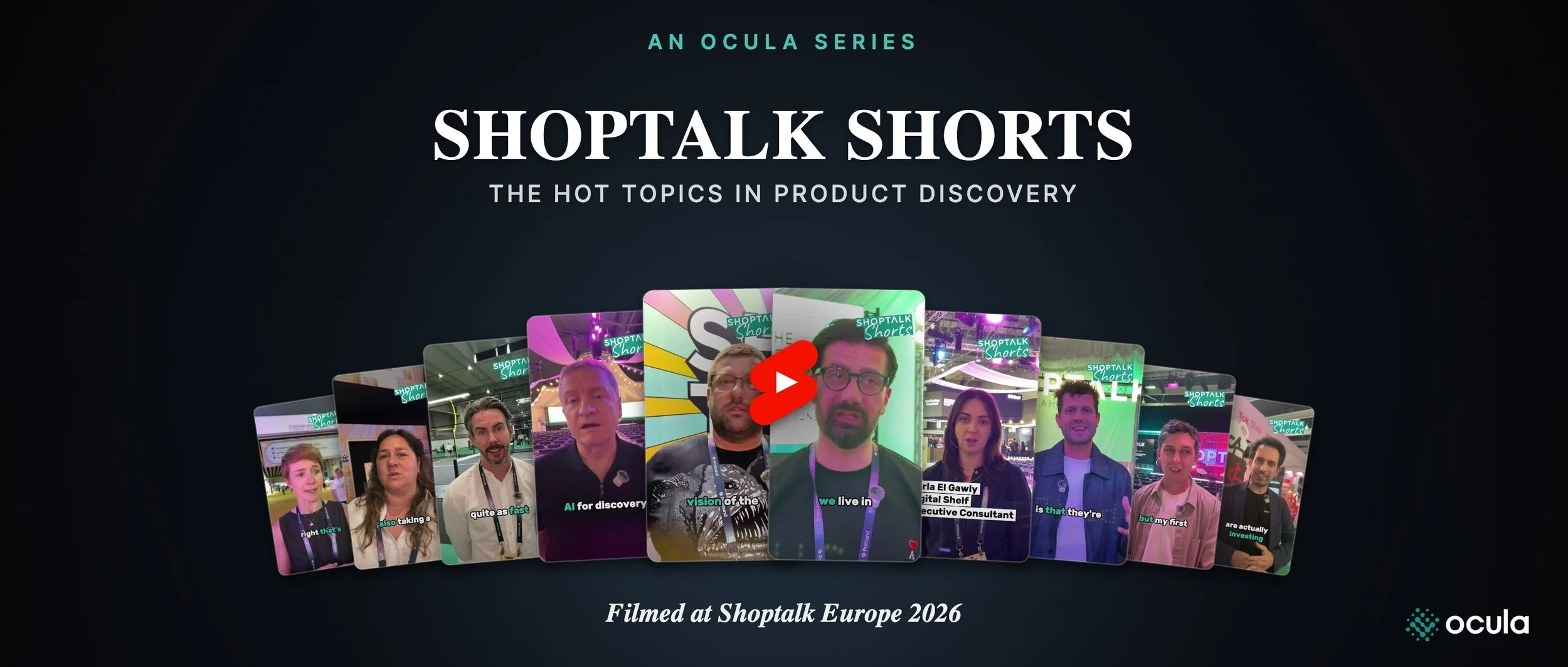
At Shoptalk Europe 2026, you couldn't walk three feet without someone mentioning the pace at which product discovery is shifting. So, we did what any sensible Marketing team would do: pointed a camera at the smartest people in the room and asked them to explain what they’re seeing.
There were some big headlines... and not everybody agreed. Agents are in. Social selling is out... or is it? UGC is the new trust currency.
We filmed the best bits.
AI & Product Discovery | UGC & Product Discovery | Social & Product Discovery | Brand & Product Discovery
Paul Archer
Founder & CEO, Duel
TikTok is the number one search engine for Gen Z to find real people talking about products.
Carla El Gawly
Executive Consultant & Strategist
Shoppers no longer just go to Google — they're asking their favourite LLMs what they're looking for.
Jack Stratten
Director, Insider Trends
Something like 70% of new luxury shoppers come through TikTok — that's how they're discovering brands.
Ceyda Erten
Co-Founder, Hilbert
Today, shoppers discover products in a much more personalised way than ever before.
Alex Baker
Founder & Principal, Nordic Retail Hub
The more digitalized we become, the more we long for that human connection.
Colin Lewis
For everyday grocery items, I don't think AI is really going to affect product discovery — those habits are already ingrained.
Thomas McKenna
CEO & Co-Founder, Ocula
Discoverability is going through the biggest change since the dawn of internet retailing.
Massimo Rocchelli
Industry Lead, TikTok
Having everything in the same app significantly reduces the time from first discovery to purchase.
Alessandra Bosco
Director of Brand Ecommerce, 11teamsports
We could even define AI as a new channel.
Egi Žaberl
CIO, akids
Grab the first AI you see and figure out how to make it match your business — then go with the flow.
Jess Crawford
GTM Lead, Ocula
The talk of the event is the impact that agentic commerce is going to have on product discovery.
Carla El Gawly
Executive Consultant & Strategist
Discoverability by agents means going back to the data foundations — is it consistent, complete, and trustworthy?
Massimo Rocchelli
Industry Lead, TikTok
Don't let fear of missing out distract you — prioritize what's coherent for your brand.
Jack Stratten
Director, Insider Trends
The currency nowadays is a real person you follow saying, on a video, "I just found this brand and it's really cool."
Paul Archer
Founder & CEO, Duel
If you want the LLMs to be talking about you, you need to get your customers talking about you first.
Alex Baker
Founder & Principal, Nordic Retail Hub
If it's a completely cold relationship, the discovery journey starts in an LLM.
Jess Crawford
Go-To-Market Lead, Ocula
There's a huge opportunity for retailers and brands to collaborate ever more closely.
Colin Lewis
User-generated content is at the very heart of the change in discovery.
Thomas McKenna
CEO & Co-Founder, Ocula
Most retailers don't do it today, but it's going to be the difference between being relevant for that latest prompt on Gemini and not.
Carla El Gawly
Executive Consultant & Strategist
When LLMs look for a product, they call upon the reviews on product pages to understand customer intent.
Massimo Rocchelli
Industry Lead, TikTok
The product goes to the user through the video and the content — this completely changes the paradigm of being discovered.
Jack Stratten
Director, Insider Trends
A lot of legacy brands know TikTok is a growing force — but they don't know how to speak to these newer consumers.
Colin Lewis
UGC creators and influencers are actually helping break that divide.
Paul Archer
Founder & CEO, Duel
So many brands say they can't afford to reward their customers — but they can afford a massive out-of-home advert.
Carla El Gawly
Executive Consultant & Strategist
Customers aren't searching for "Father's Day gifts" anymore — they're searching for "a gift for my dad who likes golf and travels a lot."
Jack Stratten
Director, Insider Trends
Organic, earned media has a new relevance and power in the age of AI.
Swipe or use the arrows to browse all clips →
AI & Product Discovery
Colin Lewis, Managing Director at Retail Media Works
For everyday grocery items, I don't think AI is really going to affect product discovery — those habits are already ingrained.
— Colin Lewis
Colin Lewis works with brands and retailers on their retail media strategy.
He believes AI discovery is now part and parcel of how we think about the world in Ecommerce. But, he points out, there are a couple of nuances here: it's not the same across every category.
If shoppers are looking to buy something they're very passionate about, like a hobby where they might want to spend their own money, Colin explains that they'll use AI to find out as much about the item as possible. The same goes for higher-ticket items, like an electric toothbrush.
However, for everyday items, Colin doesn't think AI is really going to affect product discovery, because we already have habits ingrained.
Cara El Gawly, Executive Consultant at Digital Shelf
Shoppers no longer just go to a search bar — they're asking their favourite LLMs what they're looking for.
— Carla El Gawly, Executive Consultant & Strategist
Carla El Gawly is an executive consultant and strategist focusing on digital shelf, PIM, PXM, and agentic commerce.
Carla is seeing a dramatic change in the way shoppers discover products. No longer do they search directly on a retailer's website, or go straight to Google and Amazon. Instead, they're asking their favourite LLMs for what they're looking for. Shoppers use natural language, she notes, showing their intent in a way that's broad and intentional. Customer expectations are evolving too: they want easy answers, and they want the right products recommended to them with speed and ease.
Carla sees product content as one of the core factors influencing how LLMs surface products. That means going back to the data foundations: do you have the right product information, in the right format, taxonomy, and governance, for it to be adapted and shown by agents?
Discoverability by agents, she explains, comes down to a few things about the data — is it consistent, is it complete, is it trustworthy? All of which means returning to the source of the data and making sure it meets those needs.
Swipe or use the arrows to see more →
Alessandra Bosco, Director of Brand Ecommerce at 11teamsports
We could even define AI as a new channel.
— Alessandra Bosco
Alessandra Bosco is Director of Brand Ecommerce at 11teamsports.
Alessandra observes that people are transitioning into a new way of buying and looking for products. But, she feels, the new generation of shoppers are faster and less interested in social selling. They know what they want, and just want to understand how to obtain it as quickly and cheaply as possible. That's why she believes AI is taking up so much space in the purchasing world.
She says we could even define AI as a new channel, in a way. She envisions trust growing in the future, as we move into this agentic era.
Jessica Crawford, Head of GTM at Ocula
The talk of the event is the impact that agentic commerce is going to have on
product discovery.
— Jess Crawford, Go-To-Market at Ocula
Jess Crawford leads Go-To-Market for Ocula.
According to Jess, the hottest topic at Shoptalk Europe was the impact that agentic commerce is going to have on product discovery. She sees that as falling broadly into two buckets.
The first is customers increasingly leveraging answer engines as part of their product discovery journey.
And then, she observes, the focus is more future-looking, examining how shoppers might build and leverage their own agents to shop autonomously for them on platforms.
Thomas McKenna, CEO and Co-Founder at Ocula
Discoverability is going through the biggest change since the dawn of internet retailing.
— Thomas McKenna
Thomas McKenna is CEO and Co-Founder at Ocula.
Discoverability, he says, is going through the biggest change since the dawn of internet retailing. As customers, a lot of purchases now are starting on an app, and what the apps suggest to us influence what we go on to buy.
Today, he notes, most retailers have a really narrow set of attributes — intentionally narrow, so products were easier to handle manually. In the AI era, his advice is to create a much broader taxonomy for your products, and then enrich it through image analysis and web research. Secondly, he encourages brands and retailers to start building their products' semantic layer from all the information out there about the products they sell: including forum posts, customer reviews, and expert reviews. He tells brands to collect that information and use it to inform things like the product descriptions you write and what you post to Google Shopping.
Swipe or use the arrows to see more →
Alex Baker, Founder and Principal at Nordic Retail Hub
The more visible, emotional, and touchable your brand, the easier the product discovery journey will be for the consumer.
— Alex Baker, Founder & Principal, Nordic Retail Hub
Alex Baker is the Founder and Principal of Nordic Retail Hub.
The more campaigns we're bombarded with as consumers, he argues, the less of an impact they have. For brands that activate all year round, making themselves more visible, more emotional, and more touchable for the consumer is going to make the product discovery journey a bit easier.
If your contact with the customer is a completely cold relationship, Alex suggests that these days, it'll start in an LLM. But if your customer has some kind of preexisting emotional connection to the product, then obviously the product discovery journey will look different.
Egi Žaberl, CIO at akids
If you're a bigger company, go for a custom LLM.
— Egi Žaberl
Egi Žaberl is CIO at akids.
akids boasts a wide range of products for babies and kids, across retail and wholesale, counting over 120,000 SKUs.
Egi thinks businesses should move quickly when it comes to AI, ideally finding a custom product that's tailored to their structure, their thinking, and their vision.
However, the size of a business can be a serious limitation, Egi says. "If you want a custom LLM, it's pricey." Therefore, smaller companies have little choice but to opt for general LLMs.
Jack Stratten, Director at Insider Trends
Organic, earned media has a new relevance and power in the age of AI.
— Jack Stratten, Director, Insider Trends
Jack Stratten is Director of Insider Trends, a global retail trends consultancy.
Jack thinks user-generated content's dominance can be partly attributed to AI. AI is collapsing the discovery funnel, so people find information very quickly and then don't click through to a retailer's website. That's happening constantly, he observes, and as a result brands don't really know what to do: they don't know the right places to invest, and their paid media is falling flat.
This, Jack argues, is where user-generated content becomes incredibly important, because organic media is suddenly very valuable. He likens it to old-school SEO: you just need high-quality, relevant, people-created content that feels real and authentic.
Social & Product Discovery
Massimo Rocchelli, Industry Lead at TikTok Shop
TikTok completely changes the paradigm of being discovered.
– Massimo Rocchelli
Massimo Rocchelli is Industry Lead at TikTok Shop.
Massimo says brands need to understand what discovery through content means, as distinct from the standard ecommerce experience. Where a user normally goes onto an ecommerce platform to search for a brand, on entertainment media platforms like TikTok, the product is delivered directly to the user through video and content. This, Massimo says, completely changes the paradigm of being discovered.
Brands need to select the right product for the audience they want to target, he explains, but also combine it with the right content — whether direct content or, increasingly, UGC and small micro creators who help them reach new communities more efficiently.
Paul Archer, CEO & Co-Founder at Duel
TikTok is the number one search engine for Gen Z, who use it to find real people talking about products.
— Paul Archer, Founder & CEO, Duel
Paul Archer is Founder and CEO of Duel.
Paul recalls the old way of searching, where shoppers would find product via Google, and then go and read reviews. But, he claims, that journey is evolving. Firstly, Paul says, more and more shoppers are using LLMs to search for products. The LLMs scroll through all those reviews and user-generated content for you, from Reddit posts onwards, to recommend the best product.
Secondly, when shoppers are weighing up a purchase, the majority — particularly Gen Z — go onto social media. TikTok, he says, is their number one search engine for finding real people talking about products. These consumers want to watch videos of authentic users, not polished marketing pieces or a paid influencer pretending to like the product. The smaller and more authentic the audience, he believes, the more likely they are to purchase a product off the back of a positive review.
Jack Stratten, Director at Insider Trends
Something like 70% of new luxury shoppers come through TikTok — that's how they're discovering brands.
— Jack Stratten, Director, Insider Trends
Jack Stratten is Director of Insider Trends, a global retail trends consultancy.
Jack believes that TikTok and entertainment media more generally are the key reason people's habits are changing online. TikTok, he observes, is packed with organic media people are genuinely interested in, and voices they trust.
According to Jack, "something like 70% of new luxury shoppers come through TikTok". The shopping experience as we know it, he says, is really shifting.
UGC & Product Discovery
Alex Baker, Founder & Principal at Nordic Retail Hub
The more digitalized we become, the more we long for human connection.
— Alex Baker, Founder & Principal, Nordic Retail Hub
Alex Baker is Founder and Principal of Nordic Retail Hub.
With a decade of experience in UGC, he's enthusiastic about the power of a consumer hearing from another consumer rather than from the business itself. And he thinks now, more than ever, the more digitalised we become, the more we long for human connection.
UGC plays a very important role, he says, in understanding whether a brand can be trusted to offer value.
Colin Lewis, Managing Director at Retail Media Works
User-generated content is at the very heart of the change in discovery.
— Colin Lewis
Colin Lewis works with brands and retailers on their retail media strategy.
According to Lewis, there's a big change that's occurred in the last few years, and it's rooted in the amount of time people spend on their mobile phones. These days, the phone is the portal into the universe. And one of the big things people do on their phones is look at social media — be it TikTok, Pinterest, or Facebook. People are using their thumb to find out about new products and discover new things.
UGC, or user-generated content, is essentially at the core of this change in discovery. We're living in a fragmented online world where everybody gets a different algorithm, a different online experience.
Dealing with people who are seen as more authentic — who speak directly to their audience — is, Lewis says, a much better way to reach as many people as possible.
Jack Stratten, Director at Insider Trends
Swipe or use the arrows to see more →
A lot of retailers, particularly legacy brands, don't know how to thrive on TikTok.
— Jack Stratten, Director, Insider Trends
Jack Stratten is Director of Insider Trends, a global retail trends consultancy.
How do you cut through on TikTok? The traction is with real people, according to Jack. It's not a major brand campaign that pays the person with the most followers; that might earn brief traction, but the newer brands that really explode, he observes, do so off the back of 500 different real people who've simply decided they like the brand.
It's difficult, he admits, to generate this kind of buzz, but the future is finding ways to create that organic content in an authentic, believable way. In contrast, it isn't authentic for a big luxury brand to say "look at this amazing product." What customers want now, Jack explains, is a real person they follow and like, recommending a brand and product.
Some brands are naturally good at storytelling, he acknowledges — exciting products, incredible stores, things that pop in the entertainment-media world. But a lot of retailers, many of them legacy brands, don't really know what to do with TikTok. They know it's there and that it's a growing force, he says, but he's not sure they know how to speak to the newer consumers discovering brands in different ways.
Too often, Jack adds, legacy brands approach these channels by simply spending money: on collabs, on paying a celebrity or a big influencer. And in his experience much of that falls flat, because it lacks the authenticity that genuinely draws younger consumers into a brand's world.
Carla El Gawly, Executive Consultant at Digital Shelf
When LLMs recommend a product, they call upon product reviews to understand customer intent.
— Carla El Gawly, Executive Consultant & Strategist
Carla El Gawly is an executive consultant and strategist focusing on digital shelf, PIM, PXM, and agentic commerce.
According to Carla, UGC has always had a huge influence — through ratings and reviews, Q&A, or visual content on social platforms. In a similar way, it's also highly influential for brands aiming to show up on LLMs. The rich content within reviews is natural language, the same language customers themselves use. So when LLMs try to find a product based on customer language, Carla explains, they call upon the reviews sitting on product pages to understand whether it meets the exact needs of that customer.
Paul Archer, CEO & Co-Founder at Duel
If you want LLMs to be talking about you, you need to get your customers talking about you first.
— Paul Archer, Founder & CEO, Duel
Paul Archer is Founder and CEO of Duel.
Paul says that retailers and brands need to rethink how to get all the people who love their brand to talk about it more openly. This includes how to get them talking about your brand on Reddit and in forums, leaving reviews, and posting on social. Because this genuine, user-generated content, Paul explains, is what powers everything else: every answer engine and LLM is searching through these opinions to form its answer.
So, if you want the LLMs talking about you, you need to get your customers talking about you first. That's the first-principles part; the rest is measurement and optimisation.
Brand & Product Discovery
Jessica Crawford, Head of GTM at Ocula
There's a huge opportunity for retailers and brands to collaborate ever more closely.
— Jess Crawford, Go-To-Market at Ocula
Jess Crawford leads Go-To-Market for Ocula.
She thinks there's a huge opportunity right now for retailers and brands to collaborate more closely. She flags the strength of the data that is currently sent from manufacturer into retailers, as well as the synergy between brand content and how we drive share of voice and share of mind. Finally, she highlights the operational efficiencies and logistics that need to sit underneath.
Massimo Rocchelli, Industry Lead at TikTok Shop
Having everything in the same app significantly reduces the time from first discovery to purchase.
— Massimo Rocchelli
Massimo Rocchelli is Industry Lead at TikTok Shop.
Masssimo belives that brand campaigns and product discovery are increasingly linked. The launch of TikTok Shop, he explains, means that the entire product buying journey sits in the same app. Driving discovery through content significantly reduces the time from first discovery to the point where a user can actually buy the product.
This can increase ROI for brands investing in campaigns, he notes, but it can also help user-generated content become more integrated within brand campaigns — bringing everything onto one platform, with an algorithm that matches the two together.
Carla El Gawly, Executive Consultant at Digital Shelf
Customers aren't searching for "Father's Day gifts" anymore — they're searching for "a gift for my dad who likes golf and travels a lot."
— Carla El Gawly, Executive Consultant & Strategist
Carla El Gawly is an executive consultant and strategist focusing on digital shelf, PIM, PXM, and agentic commerce.
Brand campaigns have always been something teams invest in, Carla says, and they remain incredibly important, especially for seasonal products. But campaigns built around specific events may not be as useful as they once were. Customers aren't necessarily searching for "Father's Day gifts" any more, she explains, but using LLMs to get more specific, instead searching for "a gift for my dad who likes golf and travels a lot."
She advises retailers to think beyond brand awareness campaigns to instead highlight what the product is actually intended to do, and how it meets customers' specific requirements.
Colin Lewis, Managing Director at Retail Media Works
Many brands miss the fact that audiences can also discover them organically.
— Colin Lewis, Retail Media Works
Colin Lewis is Managing Director at Retail Media Works. He works with brands and retailers on their retail media strategy.
He highlights that a lot of brands see brand campaigns as pushing a message out to the audience, and they see discovery as something where you actually go out and find customers yourself.
The big problem with this, he says, is that brands feel they have to deliver messages out to audiences, rather than focusing on the fact that audiences could discover them. So, in Lewis' opinion, there's a big divide there — and he doesn't see that divide changing any time soon.
Paul Archer, CEO & Co-Founder at Duel
So many brands say they can't afford to reward their customers — but they can afford a massive out-of-home advert.
— Paul Archer, Founder & CEO, Duel
Paul Archer is Founder and CEO of Duel.
Unless a brand campaign carries a really important message that activates people who already know your brand, Paul argues, most of the time, these campaigns are just trying to optimise and drive awareness — and in most cases that isn't really why someone buys. He sees brand campaigns as a much less significant influence on purchases compared with product recommendations from a real person — a friend, a family member, an influencer with millions of followers, or even a stranger leaving a review. These organic recommendations, he says, are the reasons we actually buy.
So many brands say they can't afford to do this, Paul observes — yet they can afford a massive out-of-home advert. To him, it's a case of redistributing some of that budget into showing up for and rewarding your customers.
More Advice for Ecommerce Leaders
Ceyda Erten, Co-Founder at Hilbert
Today, shoppers discover products in a more personalised way than ever before.
— Ceyda Erten
Ceyda Erten is Co-Founder of Hilbert.
Today, Ceyda says, shoppers discover products in a far more personalised way than ever before, with access to what they need through a much deeper level of understanding. Segmentations, and all the tags placed on customers, are becoming far more granular. And that, she believes, is where the real opportunity lies — combining deeper behavioural models and richer ways of reaching a customer how and when they want to be reached, so they get what they want much faster. Our timelines, she notes, are shrinking.
Massimo Rocchelli, Industry Lead at TikTokShop
Don't let fear of missing out distract you — prioritize what's coherent for your brand.
— Massimo Rocchelli
Massimo Rocchelli is Industry Lead at TikTok Shop.
We're in a time of great innovation, Massimo says, with people starting new trends and tools and a lot of players evolving. What matters now, he advises, is prioritising what's best for your brand, moving at the speed you need — without the fear of missing out. There's so much happening, he warns, that the real risk is getting distracted by all of it.
