When Machines Go Shopping: How AI Agents are Changing Retail
What if your next million customers never visit your website? What if an agent goes on their behalf? It scrapes what it needs, comes back with a product shortlist, and the human only ever sees the answer. In this video, Dr Greg Fletcher pulls back the curtain on what it looks like when AI agents control product discovery… And what this means for your Ecommerce catalogue in practice.
When Machines Go Shopping: How AI Agents Are Changing Retail
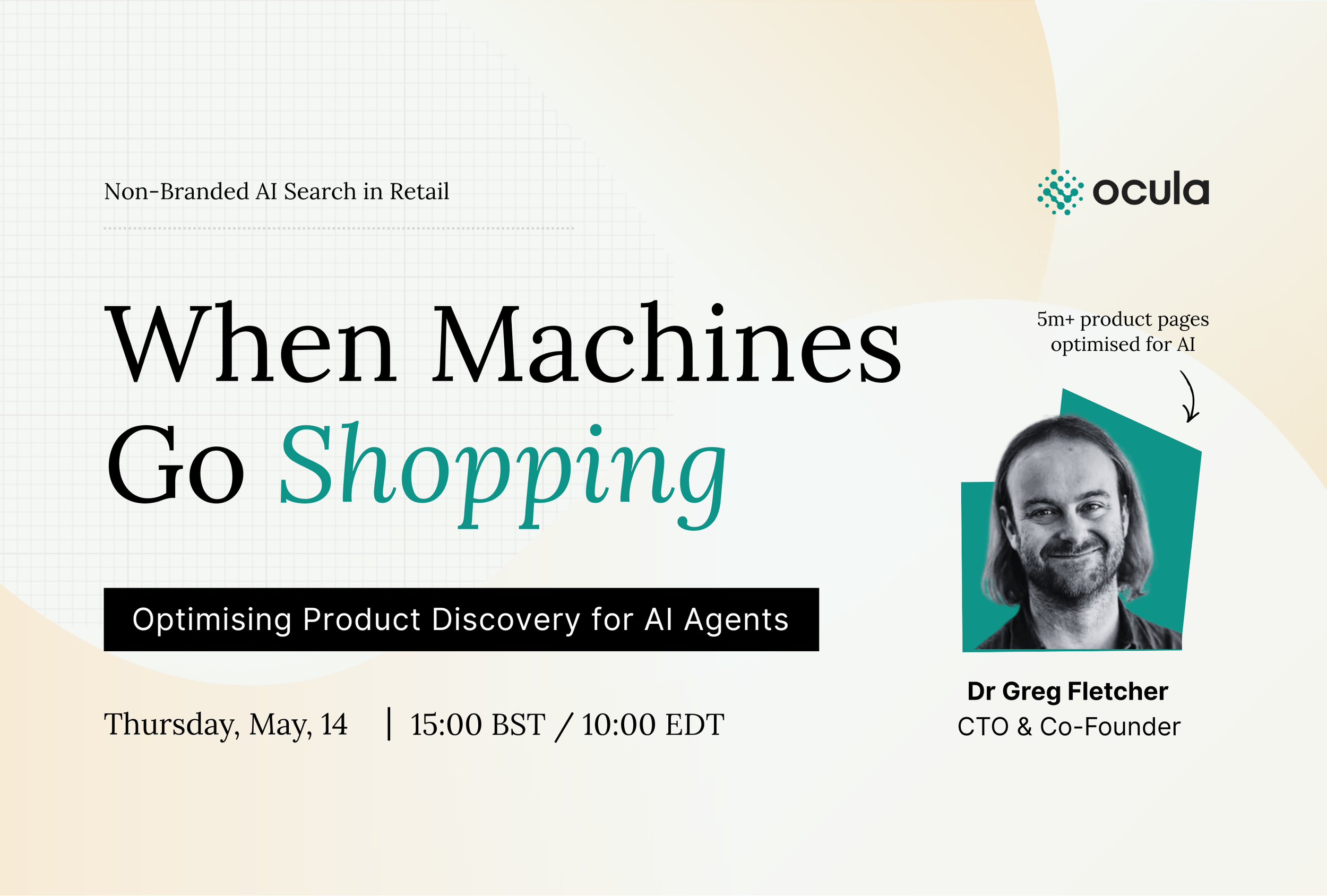
Retail's newest customer doesn't browse, doesn't click, and doesn't scroll. That was the provocation at the centre of our recent webinar, "When Machines Go Shopping," presented by Ocula Co-Founder and CTO, Greg Fletcher.
He opened with a scenario designed to unsettle anyone still thinking about ecommerce in terms of homepages and category pages. "What if your next million customers never visited your website?" Picture, he asked his audience, customers who "never click, never see your homepage, never click an ad, never scroll a category page". An AI agent has already done the recommending for them.
It's a deceptively simple framing, but it reorients the whole talk around three questions: where does the thinking happen now, what form does it take, and what can a retailer actually do about it? Greg’s experience at Ocula, working "with agents to build agents that generate data to be consumed by other agents", spent the next twenty minutes drawing on this daily, hands-on experience.
Why Traditional Product Search Fell Short
Greg's account of the old shopping journey was less nostalgic than exasperated. The picture he painted was one of sprawl: open tabs, listicles, YouTube reviews, and, failing all else, a plea to the family WhatsApp group. For brands, that fragmentation translated into dozens of scattered touchpoints to manage and optimise. It was "exhausting", and circular – yet, crucially, it was also where real deliberation happened. Decisions got made in that mess.
The shift Greg wants people to sit with isn't that AI compresses that research into a fraction of the time. That part is obvious, and welcome. It's that the reasoning itself hasn't disappeared, just because it's faster. It has simply relocated, and changed shape entirely. That reframing is really the thesis the rest of the talk builds on.
Thinking didn’t vanish; it moved into the machine.
Agentic Commerce Is Already Happening
Anticipating sceptics in the audience, Greg was blunt: agentic commerce and particularly AI product discovery is already underway. He gestured, half self-deprecatingly, at "the obligatory slide with some big numbers and a McKinsey citation", but used it to make a pointed argument that consumer behavior has already shifted and the commercial upside is enormous. For him, the real question retailers face isn't whether to adapt, but how quickly they can.
What separates this from past AI hype cycles, he argued, is that the plumbing already exists — protocols are live, integrations are running, and major retailers have already signed on. That's a meaningfully different claim than "AI is coming for retail" — it's closer to "the infrastructure shipped while you weren't looking".
What's in a Name? ACP and UCP
Here Greg got specific, describing the two competing standards now emerging for agentic commerce: OpenAI and Stripe's Agentic Commerce Protocol (ACP), which underpins ChatGPT commerce, and Google and Shopify's Universal Commerce Protocol (UCP), which powers AI Search Mode and Gemini. Functionally, he explained, both let agents query a retailer's catalogue, check live availability, and even initiate transactions. Think of these as schema.org for the agentic era.
To ground the point in something concrete, he pointed to Wayfair, which he'd heard present at Google Cloud Next just weeks earlier about co-developing with ACP and now running over a million products through the protocol. The implication he drew from that example was about inevitability: because ACP and UCP unlock different ecosystems of shoppers, most retailers of any scale will end up needing to support both rather than picking a side.
OpenAI vs. Perplexity: How AI Shopping Platforms Compare
Greg then contrasted the two platforms furthest along in actually transacting. OpenAI, he noted, piloted instant checkout in the US but pulled back on it in March — a detail he flagged as notable rather than incidental. Rather than owning checkout itself, OpenAI now routes shoppers to merchants' native checkout flows, effectively repositioning itself around discovery rather than the transaction. That pullback was reinforced, he added, by news just that week of OpenAI Ads, a feed letting products run as ads inside ChatGPT. This could be interpreted as a sign the company sees its edge in getting products seen, not in processing the sale.
Perplexity, by contrast, went the other direction. Its Instant Buy feature, launched in late 2025, lets customers complete checkout directly inside the chat, with PayPal as one payment rail. The number Greg wanted people to sit with was that shoppers referred from Perplexity spent 57% more per order than those referred from other AI platforms.
The Ocula CTO was careful to steer the audience away from the easy (and, he would argue, incorrect) conclusion. The lesson isn't that removing checkout friction boosts order value; that would barely need saying. His actual point was more interesting: different AI platforms are pulling in fundamentally different types of shoppers. Perplexity's research-heavy, citation-dense style seems to be attracting people who arrive already closer to a purchase decision. Practically, that means retailers tracking agent-referred revenue need to segment by which platform sent the traffic — treating it as one undifferentiated bucket will hide exactly the signal that matters.
Four Product Data Attributes AI Agents Need to Recommend You
Before getting into tactics, Greg laid out a mental model for what actually happens when a shopper asks an AI for a recommendation. The model, he explained, translates the conversational question into structured searches, pulls in parallel from web search, product feeds, and reviews, breaks all of that into small chunks, ranks each chunk for relevance, and stitches the top-ranked pieces into a synthesized answer. The detail he wanted to land hardest: the model is never reading a full product page top to bottom. It's grabbing fragments and evaluating them in isolation. That single fact is what should force retailers to rethink their entire content playbook. He argued that this is the premise underneath everything that follows.
1. Product Highlights: Writing Standalone, Chunk-Ready Copy
Because agents evaluate chunks — sometimes as small as fifty words — in isolation, copy can no longer rely on narrative flow or assumed context. A highlight that leans on "it" or "this" without re-establishing what it refers to will simply confuse an AI model, and a confused model won't recommend the product. Greg’s advice was to stop treating highlights as marketing copy and start treating them as data points: written like fact-sheet entries that make sense with zero surrounding context, not as flowing prose. It's a subtle but significant demotion of copywriting instinct in favour of something closer to structured data entry.
2. Q&A Pairs: Preventing AI Hallucination on Product Details
The stakes here, as Greg framed them, are binary and both bad: when an agent can't find an answer to a shopper's specific question, it either skips the product entirely or hallucinates a made-up answer. Well-built Q&A pairs are his proposed fix — effectively handing the model a pre-approved script instead of forcing it to guess.
He was pointed about a mistake he sees constantly: retailers simply relabelling their existing specs table as "Q&A." If a fact already lives in the structured product feed, restating it as a question adds nothing. At best it's wasted effort, but more likely it ends up as noise diluting a genuinely useful signal. Greg’s litmus test is simple: if a shopper could work the answer out from the spec table anyway, it doesn't belong in a Q&A pair; if they couldn't, it does. The value is specifically in the long-tail questions that structured data was never designed to capture.
3. Competitive Differentiators: Standing Out in AI Search Results
Once an AI model has chunked everything and possibly matched a question to an answer, it still needs a tiebreaker to decide what to surface. If distinguishing signals are absent in the data, it defaults to the crudest levers available — price, availability, or, effectively, chance. Differentiators are what give it something better to work with: an explicit statement of what makes a product distinct, whether that's weight, fit, or some other attribute competitors can't claim.
Greg tied this to a bigger shift worth pausing on. LLMs are stripping away the brand layer entirely. There's no logo, no hero image, just a synthesiaed answer, which means differentiators are arguably the last piece of a brand's positioning that survives the trip through the model. To illustrate how far this goes beyond simple keyword-ranking, he described searching "best running shoes under £100" in ChatGPT and getting not one answer but several, because the model had silently exploded the query into dimensions like comfort, durability, use case, and performance and built a composite response from all of them. In 2026, retailers are no longer optimising for a single search phrase the way they might for Google. Instead, product content needs enough range to be found across every angle of that fanned-out LLM query. What used to be the job of blog posts, comparison sites, and category pages, he suggested, has effectively migrated into the product data itself.
4. Use Cases and Intent Tags: Matching Conversational and Voice Search Queries
Greg used a real client example to make this concrete: a tactical gear brand based in the US, whose customers use AI to search for products like "durable pants with lots of pockets for shift work". This is a ten-plus-word request containing almost no conventional keywords. The agent has to infer intent and map it onto product attributes, which only works if the underlying data already speaks that language. Intent tags, in his framing, are the translation layer — explicitly stating who a product is for and what problem it solves, rather than leaving the model to guess.
He flagged this as a trend that only intensifies with voice search, where a typed ten-word query tends to balloon to twenty-five or more words when spoken aloud. More conversational input is, in theory, more useful context — but it also raises the bar for how detailed and additive product attributes need to be to keep up.
Why Freshness and User-Generated Content Build AI Trust Signals
A recurring thread in Greg's talk was that AI models seem to weight authenticity over polish. A candid product review, a Reddit comment, or an offhand editorial mention can carry more influence than brand-written copy, precisely because it wasn't written by the brand. His explanation was that models are increasingly checking whether a retailer's product claims line up with the broader consensus circulating online — which he framed as an opportunity rather than a threat, since it rewards retailers willing to let outside voices shape their own product story.
He sketched out what that could look like in practice: a review feeding directly into a new use case, a Reddit thread shaping a Q&A entry, an editorial mention sharpening a differentiator. Stitched together, that turns a static listing into something closer to a living document — continuously enriched and, as a result, more likely to be the chunk an AI agent chooses to surface over a competitor's.
Greg was careful not to let the more sophisticated tactics overshadow the unglamorous basics: GTINs and MPN identifiers, structured shipping data, and genuinely real-time — not batch-updated — stock information. None of these are differentiators are sufficient on their own, he noted, but skip them and a retailer risks not being cited at all, regardless of how good the rest of the content is.
He returned to trust as the throughline connecting all of it. Product data needs to be clean and reliable, or models will simply start ignoring the source — a dynamic he compared to how Google treats sites that consistently disappoint searchers, except, in his view, the AI feedback loop punishes mistakes faster and less forgivingly. The example he used was blunt: a feed claiming "in stock" when the item isn't triggers a checkout error, and the agent stops surfacing that retailer's products going forward. His warning was that trust erodes quickly and rebuilds slowly, which makes stale data a genuinely expensive liability rather than a minor inconvenience.
The Scale Challenge: Enriching Product Data Across Thousands of SKUs
Here Greg's tone shifted from tactical to structural. Most retailers' content pipelines, he argued, were built for a Google crawler and a human reader — a design that made sense years ago and simply doesn't hold up against what agentic commerce now demands. The resulting gap between what's needed and what most retailers currently have, he suggested, cuts both ways: it's a real problem, but also a meaningful opening for whoever closes it first.
To make the scale of the problem tangible, he walked through the maths for a retailer with 100,000 SKUs: each one needing an enriched title and description, roughly 30 structured attributes, use case tags, compatibility data, differentiators, plus multilingual and channel-specific variants. Even at a conservative 15 minutes per SKU, that adds up to roughly 12 people working full-time for over a year just to reach a baseline — and that's before factoring in that the work is never really finished, since pricing shifts, products change, and the broader conversation around them (via UGC) keeps moving.
His conclusion practically wrote itself, and he said as much with a wink: a task this repetitive and this large is a poor use of human time but a natural fit for AI agents. He stopped short of pitching Ocula directly — "this isn't a sales call" — but the implication was hard to miss.
On measuring success, his advice was to retire some of the old habits: track citation rates, meaning how often a brand shows up inside LLM responses for its category, rather than leaning solely on page views, and pay attention to conversations referred in from other AI platforms rather than treating all traffic as one undifferentiated stream.
Greg closed with a condensed action plan for retailers wanting to start now rather than later:
Audit your data: map every attribute against what an AI agent actually needs, and let the findings guide priorities.
Enrich your data: treat this as a job for AI agents, not manual teams.
Unify your product data so it's consistent across every channel.
Establish a baseline to measure progress against.
Start tracking whether LLMs can actually find your products in the first place.
Rounding out the session, Greg invited attendees curious about their own products' readiness to respond to a poll in the comments, offering to show what an audit might reveal for a couple of their SKUs. He pointed people toward Ocula Technologies on LinkedIn for ongoing coverage of the space, and toward a demo booking link for anyone wanting to see the ideas applied to their own catalog.
He left the audience with what amounted to the talk's real thesis, stated plainly: retailers investing in structured, enriched product data now will compound that advantage as agentic commerce scales, while those who wait will spend the next few years playing catch-up. With that, he thanked the audience and opened the floor for questions.
Related Posts