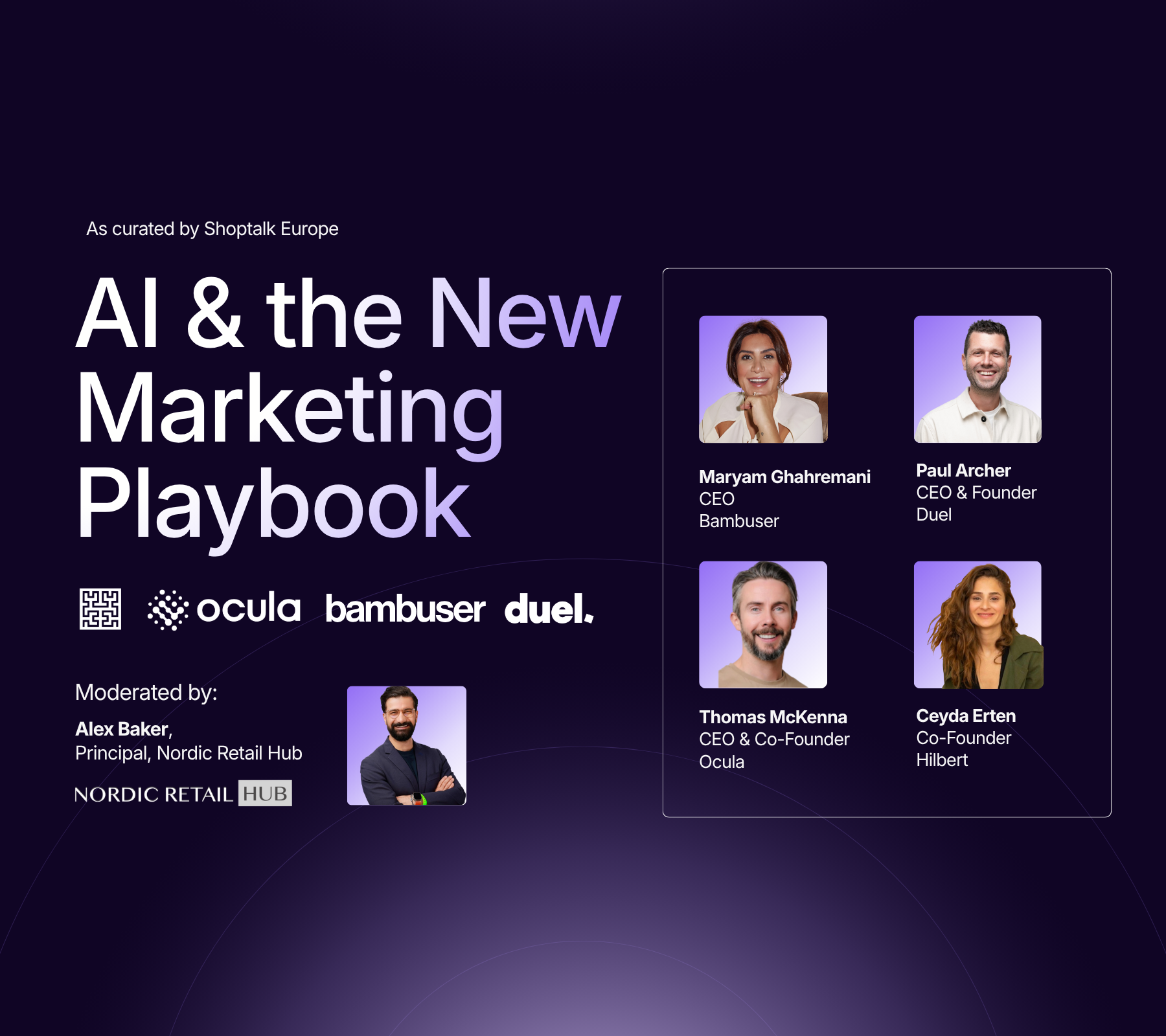
AI & The New Marketing Playbook
29th July 2026, 14:00 - 15:00

Meet The Speakers
Thomas McKenna

Thomas McKenna is Co-Founder and CEO of Ocula, the product content optimisation platform that helps Ecommerce leaders at multi-category retailers stay AI-discoverable, channel-searchable, and consistently cited. Ocula's AI agents enable major brands like Argos, CEX, and Five Below to increase site traffic by 7–12% through product enrichment, product content creation, and feed optimisation.
Ceyda Erten

Ceyda Erten is Co Founder of Hilbert, the AI-native growth infrastructure built for B2C companies. Hilbert is a scalable, data science-first technology that provides B2C teams predictive clarity into user behavior, revenue drivers, and the actions that drive sustainable growth.
In her role, Ceyda leads the company's strategy to become the definitive growth operating system for omnichannel commerce. An operator and strategist, her career spans transformation leadership at Getir and FreshDirect, where she led post-acquisition change, executive hiring, and multi-continent M&A. She holds graduate degrees in Political Science and International Politics from Northwestern and Georgetown, and is fluent in English, Turkish, and French.

Maryam Ghahremani
Maryam Ghahremani has been the CEO of Bambuser since 2018, post-IPO and has been leading the company’s vision and strategy to reshape traditional commerce through the power of shoppable video. With over 15 years of experience in media, marketing, and entrepreneurship, Mary is also a member of the board of directors at Stiftelsen Internationella Företagare i Sverige (IFS), a foundation that honors and supports international talented entrepreneurs.
Paul Archer

Paul is co-founder and CEO of the brand advocacy platform Duel (used by Abercrombie & Fitch, Victoria’s Secret, Charlotte Tilbury, and 60+ other brands to manage their communities). Through his work with global brands, Paul has championed advocacy as a growth strategy, turning customers and communities into a key driver of brand loyalty and engagement. Paul also co-hosts the top marketing podcast "Building Brand Advocacy."
AI & The New Marketing Playbook: Transcript
Alex Baker (Moderator): I'm Alex Baker. I'm the principal at Nordic Retail Hub, and very excited to once again be speaking to Thomas McKenna, Ceyda Erten, Maryam Ghahremani, and Paul Archer today to discuss “AI & The New Marketing Playbook”. I first had the chance to speak with these four smart individuals for a session at ShopTalk Europe earlier this summer; as you can imagine, it was a very popular panel due to the topic.
Whereas traditional marketing has focused heavily on ‘renting’ audiences and optimising for search engines, what we’re seeing in 2026 is the rapid transformation of that status quo with the rise of AI-driven product discovery. Regardless whether you're a retailer, or a brand, or just personally AI curious, you’re probably becoming more aware that this shift is not your typical tech upgrade. Rather, AI search is proving a direct challenge to product discoverability, to schema structures, and – perhaps most importantly – to your margins.
This session is focused entirely on operational strategy. We’ll answer all your burning questions about how to allocate your budget, how to work to make your product data machine-ready, and even how you can build your community channels to stay afloat in an AI world.
Today’s session is about 45 minutes in total. In that time, you're going to hear a 5 minute presentation from each of our four speakers in turn, followed by a panel discussion at the end where they debate questions from the audience. If you’re interested in hearing more from any of the service providers sharing their insights today, you can let them know by filling out this poll.
5 minutes with Duel: How AI Search has rewritten influencer marketing
Paul Archer (Duel):
I’m founder and CEO of Duel, a brand advocacy platform. We work with large retail brands to help them build out communities of advocates and creators, brand ambassadors and affiliates, driving growth through social commerce.
There are several ways that growth has changed in the AI era. They’re all quite connected when we think about it from a marketing perspective, and from a brand and retail point of view.
To start with, I want to establish that UGC – user-generated content – is really what’s commanding the vast majority of people's attention these days. People spend more than twice as much time on creator-led platforms, like TikTok, YouTube, and Instagram, as they do on every other media channel combined. This means that UGC has democratised content consumption, giving platform to an amazing diversity of thought – especially when you consider the degree to which content used to be centralised, controlled by major news and publishing outlets controlled by Rupert Murdoch and co.
Gen Z now usesTikTok as its number one search engine. They search on TikTok to find real people talking about a product. Not influencers who have been paid to shill the product, not what the brand has to say about themselves in ads, but real people sharing authentic opinions on the product, how it works, and how it looks.
In a similar way, we’re also seeing a shift towards authenticity in the way we search. Whereas it used to be imperative to optimise for SEO if you wanted your products to be discovered organically, now, we’re actually seeing traditional search threatened by answer engines like ChatGPT. Large language models canvas the internet to find out people's opinions and help users make decisions about the products they want to buy. What's really interesting is that these LLMs aren’t going to brands’ websites to find the best products, except to reference specific product details via product specs or FAQs.
No, what the LLMs are looking for are real humans' opinions: user-generated content, reviews, social media posts, Reddit. All of these things inform the answers that LLMs output, and allow the LLM to make a decision for the user with a single sentence product recommendation.
On social media, likewise, the AI algorithm is also changing what we see. Of course, we think we’re somewhat in control of what we see on social media, but actually, 90% of what we see when we're scrolling through Reels or through TikTok is actually content from people we haven't chosen to follow. This is content that an AI algorithm has decided that we might like… and it often understands more than we do about our preferences and interests.
In the past, the number of followers you had was proportionate to the number of people that saw your post. Now, however, it’s actually barely even correlated. The number of followers you have has got almost nothing to do with how many people see your post.
This is changing almost everything that brands know about the way that they want to work with creators.
We've built up a whole industry of influencer marketing over the past 5-10 years based on followers. Pricing, campaigns, budgeting is all based on followers. Deciding whether someone is a microinfluencer or a nanoinfluencer – again, based on followers. But the algorithmic shifts we’re seeing now actually make this way of thinking irrelevant. Because the algorithm decides what we see, not what or who we choose to follow.
This leaves a really big question for brands: how can we grow in 2026 and beyond?
A lot of it comes down to building the systems that drive growth.
It's not about campaigns anymore or creativity. It's about systemizing brand advocacy, systemizing the conversation, systemizing the social commerce that comes from it, because you've got to have a lot of people talking about you. You're not going to get discovered with just one person making noise about your product.
This is the first principle of growth. Advocacy always starts with this concept of creating a remarkable experience so that people feel compelled to remark upon it. Yet we spend most of our time hunkered up in the weeds of our budgets, spending time on the peripheries, on the secondary things. But actually, what we need to do is figure out how do we get more people talking about us. That's very much something which we obsess about here at Duel: because the more advocacy systems a brand has in place, the faster they grow. Being someone who's building communities, building systems, building repeatable models that happen again and again and again – that’s the secret to Ecommerce growth this year.
Where should you start? You know, a lot of brands will have up 15 different tools for managing community growth. Honestly, you just don't need that anymore. You don’t have to have a separate strategy for TikTok, and Snapchat, and Instagram, and YouTube, and YouTube Shorts. If you try to, you’ll soon find that it’s incredibly overwhelming. But actually, when you look closer, you realize that the same individuals are creating content across all of these platforms. And if you were to build a single strategy instead of multiple strategies, you could actually still start systemizing growth.
It really starts with focusing on an individual. Get to know your customer: what they spend, what social platforms they use, what they post. You can build up a scheme that gets more products into their hands, which in turn gets them to write more reviews, post more about your products, and so on. The flywall starts to spin faster and faster – and it all starts with a relationship.
Duel is the market leader in the industry for building out these advocacy communities at massive scale. It's a portal that is completely white-labeled for brands that create a gamified experience for advocates, creators and brand ambassadors.With this, a brand can build community, can build a program that can drive growth, and have a ready-made back-end console for managing it at massive scale.
Of course, the only reason we can do this is because of the AI that is baked into this platform from the get-go. Our ambition is that we want to display every single advocate for a given brand in one place, tracking all of their different activities, all on one platform.
5 minutes with Ocula: Why strong product data is the key to AI Search visibility
Tom McKenna (Ocula): I’m Thomas McKenna, the Co-Founder and CEO of Ocula. We tend to work with brands and retailers who have large product catalogues, optimising product pages and product data for discoverability across Google, Amazon, AI Search, and beyond.
Because of the breadth of their SKU portfolio, retailers with large product catalogues face some of the biggest challenges in optimising for AI Search. At the same time, of course, they have the biggest opportunity if they can successfully activate that long tail.
The shift towards AI Search is moving faster than the dawn of internet retailing (which irreversibly changed supply chains, changed buying habits, and so on, in its own right). Bain & Company recently reported that by 2030, 20% of Ecommerce in the US will be conducted by AI agents.
With this shift, there's going to be winners and losers. So, how do you become a winner?
My wonderful co-founder, Dr. Greg, spends a lot of time looking at what separates the winners and how to operationalize that secret to success. What's really interesting, if you look at this, is that structured data really matters. Agents predominantly send discovery traffic to product pages with structured product data.
Not to listing pages, not to blogs, not to home pages. The humble product details page finally has its time in the sun. The agents are looking at those thousands of (somewhat unloved and generic) to decide whether your site is better than your competitors. That’s why you have to make sure that you're giving them the love and attention they need.
How do you do that? If you've got poor product data, you are invisible. You are losing revenue. You probably don't know exactly how much, because you won't be seeing it, but you will have a massive opportunity cost and lost revenue that your CFO would love you to be capturing. So how do you become the CFO's best friend?
Do three things better than your competitors.
Step 1: Enrich your underlying attributes. Your taxonomy matters. Expand your taxonomy with the attributes that are important. Make sure you have the relevant values in there.
Step 2: Bake rich semantic data into your product pages. There’s so much advocacy, user-generated content, and customer reviews out there about the products you sell: now’s your time to get that collateral. It really describes what the product is good for far more effectively than generic manufacturing or dry marketing copy ever will. Maybe your product’s won an award, maybe it’s got amazing Amazon reviews. You need to know about that, and so do your customers. And bear in mind, your reviews are constantly changing – therefore your product description needs to be constantly evolving.
Step 3: Get your product pages ready for each channel. You're going to sell that moisturizer or that t-shirt through your own website, you're going to sell it on Google Shopping, there's going to be a myriad of different places it's going to end up. Each one of those channels should take your base layer of product data and then optimize it with your brand tone of voice for that specific channel. Your Google Shopping optimization is fundamentally different to your DTC website optimization, and so on.
So don't worry about just showing up in AI Search. Worry about having great product data that you can get live quickly. And of course, you can always use agents to optimize that data at a lower inference cost than your competitors….
If you’d like to understand more about how Ocula could improve your brand’s product data, book some time in here.
5 minutes with Hilbert: How to get your whole team speaking the same language
Ceyda Erten (Hilbert): I'm Ceyda, I'm one of the co-founders at Hilbert. We are based in San Francisco, Istanbul, Europe, and growing in Australia and Latin America. Hilbert is an AI growth infrastructure: we're a team of operators who come from B2C businesses, and so we’ve all worked deeply in various elements of growth, which of course includes marketing and extends beyond that.
We build the growth infrastructure required for the AI era, enabling teams to execute with the best decisions at the fastest speed they can. Currently, B2C infrastructure isn’t ready for a world of AI agents. There's no company on Earth that has clean data.
Our role is to go in and we work with the world’s leading retailers and beloved brands to build their source of truth infrastructure. We tend to see silos in every organization: a Marketing might be looking at KPIs that aren’t shared by anyone else in the team, and then a CFO looks at different metrics, merchants look at different metrics, and so on. Without shared context – a shared North Star, so to speak – even if every team hits their target, the company can still sometimes wind up losing.
The whole team needs to start speaking the same language. For that purpose, we tend to see lots and lots of dashboards; typically they provide more questions, rather than clear answers. Growth teams spend the majority of their time wrestling with data, with less time to spare for strategy and creativity.
At Hilbert, we try to figure out what works, what didn’t work, and why. We empower folks who want to be creative, strategic, and move the needle in a way that matters for their business. We do this with a data schema transformation, first of all, ensuring that business context is fully captured.
We then go into that data, labeling and deep learning, powered by machine learning. We show incrementality through these labels – so, we detect early churn, we detect lifetime value, and several other scores as needed.
This enables marketers and beyond to really boost their detection capability. You’re able to grasp segmented shifts ahead of time, leveraging AI technology in a grounded, deterministic way that really, really unlocks effective dollar spend. We also have a query agent, so folks can go in and get their hardest questions answered in in minutes, instead of going to a team of data scientists, asking them to pull something, and then coming back in a few weeks where the shift has already happened.
5 minutes with Bambuser: Why employee-generated content outsells influencers
Maryam Ghahremani (Bambuser): I’m Mary, the CEO at Bambuser. At Bambuser, we help brands to create more engaging commerce experience, connecting offline and online shopping through video, live shopping, and one-to-one video consultation.
Lately, of course, we have been focusing on a new challenge. Namely, how does your commerce content becomes discoverable and understandable in the age of AI?
At Bambuser, we believe that Ecommerce has been static for much too long; it starkly contrasts the store experience, where you can expect to have a person greeting you, you can ask questions, the store assistants know a lot about the product you're gonna buy. That’s why we’ve built a social commerce suite to help Ecommerce brands take that experience into the digital world, ready for the age of AI.
Our gamete includes everything from live streaming from the actual store to shoppable videos, user-generated content, and even employee-generated content. Taking your employees and making them front and centre of your brand is one of the best things you can actually do to stay discoverable in this day and age. A lot of the times, it works even better than commissioning an influencer or a big celebrity. I think the most important thing is the authenticity and the trust that you're building by spotlighting regular people as the face of your brand. I think we, as humans, really long for human connection, even online in a digital world. It’s important to be able to speak to someone directly online, a real human, an assistant, who can help me find what I’m looking for.
This is conversational commerce, and it’s really very similar to what we’re seeing now with the rise of agentic commerce via Large Language Models like ChatGPT, Perplexity, and so on. You start by presenting a challenge you have, and then you have a conversation with the AI agent to understand which products best suit your needs.
I think for the last two decades, digital marketing has really largely been built around search. Consumers have searched, brands have optimized, and traffic flowed to websites. Now, we are entering a very, very different era, and increasingly, consumers are turning to AI. When AI starts shopping on people’s behalf, that will present a very unique challenge for marketer.
At Bambuser, we've always been a video-first company, and we lead with that, but how do you take all that video, all that user-generated content, all that great data you have, and structure that to be findable and understandable by AI? So, that is precisely our new feature that we’ve now built and launched. In the world of AI commerce, brands will need to adapt in turn.
Following their introductions, the panel discussed the following questions. (Answers have been edited for clarity and length.)
How do you recommend Ecommerce teams allocate their budgets in the age of AI? What percentage do you see moving towards AI discoverability versus traditional SEO budget?
Maryam Ghahremani (Bambuser): I think this is the hottest topic right now for e-commerce or marketing teams around the world, actually. This is really a global question.
90% of search still comes via Google; at the same time, we're seeing between 10 and 20% of traffic coming from LLMs, which is not insignificant.
Taking these statistics, I would take around 10-20% of my marketing budget and go all in with that on testing GEO, AEO and other strategies to show up on AI Search. To be honest, I think good GEO is actually based on a good SEO strategy, so it goes hand-in-hand somewhat. You can't drop your SEO efforts; but you need to be curious, and you need to be on the right side of change.
How do you turn insights into business intelligence without total infrastructure overhaul?
Ceyda Erten (Hilbert): The secret is, CFOs love business intelligence. They want to understand what marketers spend money on and their returns. Likewise, marketers love being able to prove and show their impact using data. It's actually a very synergistic relationship once people start talking about the same definitions; which means that any ‘overhaul’ is supported by everyone and supportive for everyone’s role.
With this kind of intelligence, you can resurface reactivation opportunities, identify early churn, and therefroe keep and invest in your best customers while acquiring customers that you’re going to retain. This compounding sustainable growth is actually making what companies successful and enduring.
What is the advantage of a community of brand advocates compared to traditional paid advertising spend?
Paul Archer (Duel): Personally, I don’t think anyone's ever actually bought anything because of an ad. That might have been the thing that nudged you to make the purchase, it might capture existing demand, but the creation of that demand almost always comes about because of a real human. That could be a friend or family member’s recommendation, or maybe someone’s review on the internet. Crucially, we’re talking about a real user of the product, someone who isn’t just paid to recommend it.
The key now is to activate all those users to start talking about you a little bit more. If every single one of them were to have one more conversation, or two more conversations, or do one post on social media, or refer one person, you will double the size of your business. And so it's a really easy, yet very hard way of growing a business.
How can brands best automate the transition to machine-ready product data?
Tom McKenna (Ocula): Without machine-ready product data, you risk becoming irrelevant online. It's not a nice-to-have.
I think, if you don't do anything, you're going to go backwards, because the market is surging ahead towards AI discovery. Even if you have a solid P&L now, if you’re indecisive now, you won't have that market share in one, two, three years.
This is the reason that CFOs are asking the question, “Are we relevant in Agentic commerce?” They were never asking how the Marketing team was doing when it came to SEO, although SEO was important, and it drove a lot of money. But suddenly, Agentic Commerce is a C-suite discussion. So, you have to think about how you operationalize it, you have to consider deploying your own AI.
Your budget can’t support bringing in an army of people to enhance product information, or generate all the content you need. So, you need your own best-in-class AI. How do you then measure that that's working? Well, you measure how much it costs.
For example, if you're in a build versus buy scenario, how much could you build your own AI for? What's your inference cost? What's your ongoing team management versus what you're paying a provider for? And then the flip side of that coin is, how much additional revenue is the AI making us?
Set up control groups, track changes in LLM visibility, and you’ll see that you can put dollar values against all of that really easily.
So suddenly, in your quarterly review with the CFO, you're saying, well, look, this is why we've chosen this provider, or this is why we’ve built in-house. This is the cost profile, and this is the kind of ROI we're getting when we look at test versus control. It will be really compelling.
If you were advising an Ecommerce Marketing team to cut one element of the legacy Marketing stack, what would it be and why?
Tom McKenna (Ocula): I would say, stop trying to build tech yourselves, just because you can. You will end up spending a fortune, and then you will go to an AI specialist.
Paul Archer (Duel): I would tell you to cut most of advertising. If you were to reinvest that massive budget in building and nurturing relationships with your customers, you will grow far faster than you would if you were to spend that money on ads.
Maryam Ghahremani (Bambuser): I would actually kill content created for volume rather than value. That's where I would cut.
Ceyda Erten (Hilbert): I would cut out spray and pray methods. I think it’s really important to maintain a measurement system that keeps you honest; you can’t grow sustainably without one.
What’s the most important things Ecommerce teams should invest in ahead of 2027?
Maryam Ghahremani (Bambuser): I would say, let humans create the meaning, and invest in machines to automate the scale.
Tom McKenna (Ocula): Invest in product data, or become irrelevant.
Paul Archer (Duel): Invest in creating remarkable experiences for your customers so that they remark upon it to as many people as possible.
Ceyda Erten (Hilbert): I think Ecommerce teams need to invest in real-time customer data by the end of 2026, otherwise they’ll lose their best customers without seeing it coming.
Read more like this